Elemental Monsters: Merge
- 4.8
- Rating
- 1.00M
- Installs
- Free
- Price

 Analysis by App-foxy
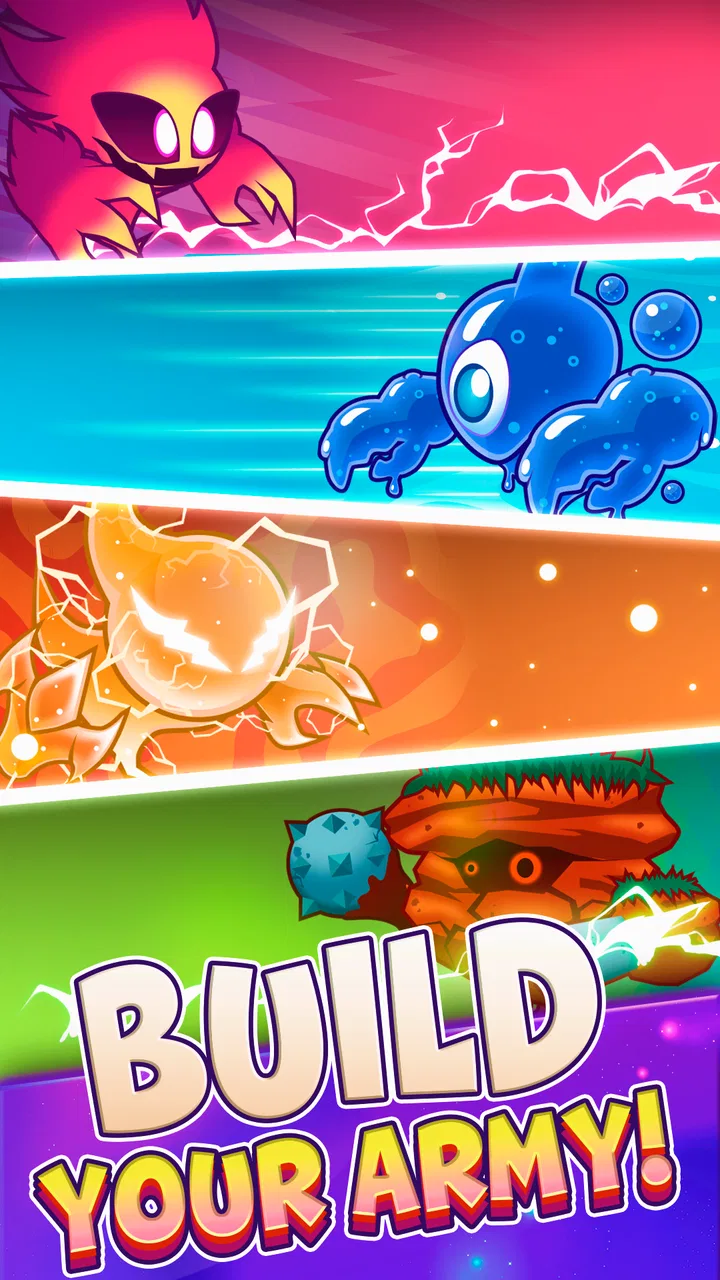
I went into Elemental Monsters: Merge expecting a light strategy game built around combining creatures, and that is exactly where its first appeal comes from. It is easy to understand, quick to start, and more thoughtful than a simple matching game because the elemental theme gives each decision a tactical purpose. You work with fire, water, earth, and air, evolve monsters, and take them into player-versus-environment duels. The result is a compact game that fits naturally into short breaks, although its ability to stay installed depends on whether you enjoy repeating a familiar improvement loop.
Developed by Go Dreams, this free strategy game is aimed at a broad audience and carries an Everyone age rating. It has already passed the one-million-install mark, with a 4.7 average from roughly thirty-five thousand ratings. Those figures suggest that the basic formula connects with a large audience, but they do not answer the more important question: does the game continue to feel worthwhile once the opening discoveries are gone? After spending time with it, I think the answer is yes for players who like gradual collection and tactical planning, but only conditionally for anyone looking for deep, constantly changing strategy.
From the first merge to a dependable routine
The opening experience is strong because the central action is immediately readable. Merging creatures feels satisfying without requiring a long explanation, and the elemental identities give the board more personality than a collection of visually interchangeable units. Fire, water, earth, and air are not just decoration in the concept; they frame the way I think about growth and battles. Even when a decision is small, I am encouraged to ask whether I should improve one creature now or preserve pieces for a more useful combination later.
You May Also Like

 Blood Strike: 2.5 Anniversary
Blood Strike’s Loadouts Turn Every Drop Into a Tactical Gamble
A close look at Blood Strike’s custom loadouts: how fast access to signature weapons reshapes its battle royale rhythm, rewards preparation, and narrows the gap between fights.

 Pandora - Music & Podcasts
Pandora’s Music Is Easy to Start, but Harder to Recover
Pandora’s strength is its low-effort path from a seed to a station. Its weak spot is how much confidence it asks you to place in connection, setup, and quiet recovery.

 8 Ball Pool
 Is Built on Rivalries, Rematches, and Routine
A close look at the rivalries, rematches, shared routines, and unanswered safety questions that turn a quick pool match into a persistent mobile community.

 Samsung Music
’s Quiet Strength Is Playing What You Already Own
Its reach comes less from spectacle than from dependable access to a personal library. That simplicity is both the app’s strongest retention engine and its ceiling.

 AccuWeather: Weather Radar
AccuWeather Review: A Quick, Clear Forecast for Everyday Decisions
For everyday plans, the best forecast is the one you can understand quickly. AccuWeather makes rain timing, radar, and local conditions easy to act on, with a few trade-offs.

 Hill Climb Racing
Why Hill Climb Racing Still Turns Crashes Into One More Run
A tiny car, a bumpy hill and one more upgrade: Hill Climb Racing keeps resurfacing because its simple chaos makes every near-miss feel personal.
More From Our News Desk



That tension is the best part of the first week. A beginner can play by instinct, but a careful player quickly notices that every merge has an opportunity cost. Combining everything as soon as possible may produce a stronger individual monster, while holding back can leave more flexibility for the next encounter. I found that this made ordinary progression feel more deliberate than the bright, casual presentation initially suggests.
The PvE duels also help the game avoid becoming a purely passive collection exercise. Battles give the creatures a reason to exist, and they provide a practical test for the choices made during merging. Instead of treating evolution as an abstract number increase, I could connect it to a specific goal: getting through the next fight, improving a weak part of the team, or preparing for a tougher stretch. That connection between the merge area and combat is what gives the game its strategic identity.
For a realistic everyday scenario, imagine opening it during a commute or while waiting for an appointment. You can make a few merges, check which creature needs attention, and finish a PvE duel without committing to a long session. I would not choose it for a focused evening of complex strategy, but it works well when I want decisions that are more meaningful than tapping through a completely automatic game. The short-session design is one of its most convincing practical strengths.
The first-week novelty also comes from seeing how the elemental groups develop. Early progress feels rewarding because each improvement is visible and understandable. I never needed to memorize a large rulebook to feel that I was learning. The game gives enough room for experimentation, which is useful for new players who want to discover their preferred approach rather than follow a rigid guide from the beginning.
Still, the opening is not flawless. Merge games naturally rely on repetition, and the first few sessions can make that repetition feel more generous than it will later. Initial progress tends to arrive frequently, so the loop feels active: combine, evolve, fight, and repeat. The important question is what happens when upgrades require more patience and the surprise of discovering the next improvement becomes less frequent.
What the elemental system adds to decision-making
The most useful way to approach the four elements is not to treat them as a checklist. I had better results when I thought about my collection as a set of options rather than a single line of upgrades. If I always merge immediately toward the most obvious improvement, I may lose the flexibility needed for a different fight. Keeping a small reserve of useful pieces can be more valuable than chasing the biggest visible creature every time.
That is a subtle but important distinction from ordinary match-and-upgrade games. The satisfying move is not automatically the best move. I recommend pausing before a major merge and asking what it changes in the next duel, not only what it changes on the collection screen. This habit is especially helpful when resources feel limited or when an evolution would leave the rest of the team underdeveloped.
Another practical tip is to judge progress by battle performance rather than by the appearance of a new monster alone. A newly evolved creature can feel like a victory, but if it does not solve the problem that stopped the previous duel, the merge may have been more cosmetic than useful. I found the game more engaging when I used each encounter as feedback and adjusted my next merges accordingly.
Why the second and third weeks feel different
After the initial rush, the game becomes less about discovery and more about maintenance. The basic actions remain enjoyable, but the emotional payoff changes. At first, nearly every session seems to move the collection forward. Later, a session may mainly preserve momentum, prepare a better team, or inch toward an upgrade that is not immediately available.
This is where personal taste matters. Players who enjoy incremental progress may find the slower rhythm relaxing. I like having a small project to return to, and the elemental theme gives that project enough structure to remain recognizable. On the other hand, if you need every session to introduce a new mechanic, surprise, or strategic layer, the familiar merge-and-duel cycle may begin to feel narrow.
The game’s current version is 2.8.6, and that makes it a sensible choice for someone who wants to try an established release rather than an early experiment. I would still judge it by the routine it creates, not by the version number. A polished loop can remain enjoyable for months, but it can also reveal its limits quickly if the player does not enjoy repetition.
Month-to-month value: what remains after the novelty fades
For me, lasting value comes from three things: whether progress remains understandable, whether battles give upgrades a purpose, and whether returning after a short absence feels welcoming rather than punishing. Elemental Monsters: Merge does well with the first two. I can usually tell what I am working toward, and the PvE structure keeps collection choices connected to play. That gives it more staying power than a merge game that offers only visual accumulation.
The month-to-month question is harder because the core loop is deliberately focused. This is not a broad strategy suite with many unrelated modes competing for attention. Its strength is that it knows what it wants to be: an elemental merging game with creature evolution and PvE battles. The trade-off is that players who outgrow that central loop have fewer reasons to remain engaged.
I would recommend it as a steady secondary game rather than as the only game on a phone. It is well suited to a routine in which I check in briefly, make a few considered improvements, and leave. That approach protects the game from becoming a chore. Playing for long stretches every day can expose the repeated structure faster, particularly once the early collection excitement has settled.
Its free entry also helps with experimentation. I can install it, learn how the merge and battle systems fit together, and decide whether the pacing suits me without paying upfront. However, free-to-play design always makes spending discipline part of the experience. The listed in-app purchases range from forty-nine cents to ninety-nine dollars and ninety-nine cents per item, so I would treat optional purchases carefully and avoid using money to solve impatience with the progression rhythm.
My advice is to set a simple personal rule before playing: enjoy the decisions you can make now, rather than assuming every delay should be removed. If the game is fun only when progress is accelerated, that is a warning sign that its long-term value may not match your habits. If the small choices remain satisfying even during slower periods, the free structure becomes much easier to live with.
There is also a useful distinction between collection value and strategic value. Completing or improving a group of monsters can be personally rewarding, but it does not automatically create deeper play. I would keep playing for the tactical relationship between merging and duels, not merely for the satisfaction of filling out a roster. That distinction helps explain why some players will stay for a long time while others will move on after the first burst of progress.
Who gets the most recurring value
The best fit is someone who likes compact strategy, visible progression, and creatures that can be improved over time. It should appeal to players who enjoy thinking one or two moves ahead but do not want a complicated interface or a long campaign commitment. The Everyone rating also makes it approachable for a wide audience, although younger players may still need guidance around optional spending.
I would also suggest it to people who like having a calm, repeatable mobile ritual. A few minutes of merging followed by a duel can become a pleasant break in the day. The game does not demand that every session become an event, and that modest ambition is part of its charm.
I would skip it if my priority were competitive multiplayer, a story-driven adventure, or a strategy game with a large number of radically different systems. The focus here is clearly the elemental merge-to-battle progression. Players who want city building, deck construction, real-time competition, or a constantly changing puzzle format will likely find a more suitable alternative elsewhere.
Maintenance, friction, and the cost of keeping the habit
Maintenance in this game is not complicated, but it is real. The collection needs attention, merges need to be considered, and battle progress gives context to the next upgrade. That is manageable when I play regularly in short sessions. It becomes less appealing when I feel obliged to return simply to avoid falling behind or to keep a slow progression moving.
The main burden is mental rather than technical: remembering what I am saving, what I am trying to evolve, and which improvement is most relevant to the next duel. A careless session can turn into a series of automatic merges, which reduces the strategic pleasure. I found that taking a moment to identify one goal before playing made the routine more efficient and prevented aimless tapping.
A good maintenance workflow is to separate collection cleanup from battle preparation. First, I decide which creatures are genuinely useful for the next objective. Then I merge with that purpose in mind instead of treating every available combination as equally urgent. Finally, I use a duel to check whether the plan worked. This three-step rhythm makes short sessions feel more complete and reduces the sense that I am simply waiting for the next upgrade.
Another trade-off is the temptation to optimize everything. The game is more enjoyable when I accept that not every move will be perfect. Overthinking a small merge can make a casual mobile game feel like administrative work. I recommend using careful planning for meaningful decisions and allowing ordinary progress to remain ordinary. That balance is important if the goal is a sustainable habit rather than maximum efficiency.
Because the game is free, spending can become part of the maintenance question. A player who is comfortable with optional purchases may find the progression easier to manage, while a player who wants a completely no-spend experience should be prepared to value patience over speed. I would not install it for a child without discussing purchases first, even though the content rating is Everyone. The age label describes the content audience; it does not replace sensible control over spending.
The low minimum operating-system requirement is another practical advantage. It supports devices running Android 7.0 or later, which makes the game accessible to people who are not using a recent phone. I would still expect the experience to depend on the individual device, but the stated requirement makes it a reasonable candidate for an older Android handset used for casual gaming.
Where fatigue begins
The first source of fatigue is predictability. Merging, evolving, and fighting form a clean loop, but clean loops can become repetitive when the player has already understood the main decision pattern. The elemental theme delays that feeling because it gives the creatures and battles a distinct identity. It does not remove the risk entirely.
The second is the changing value of progress. Early upgrades feel substantial because they arrive often and visibly. Later progress may require more patience, and the player has to decide whether preparation itself is satisfying. If I am playing only to reach the next large improvement, the quieter sessions feel thin. If I enjoy refining a team and testing choices, those same sessions remain useful.
The third is the gap between casual accessibility and strategic depth. The game offers enough decision-making to be more interesting than a purely automatic title, but it may not satisfy players who want elaborate planning, multiple interacting systems, or a wide range of viable approaches. Compared with a traditional strategy game, it is easier to enter and easier to play in short bursts, but it is also more concentrated and less expansive.
Compared with a standard match-three game, it has a clearer sense of long-term ownership because the result of a merge becomes part of a creature-focused progression. Compared with a creature collector, it puts more emphasis on combining and evolving than on building a large narrative world. Compared with an idle game, it asks me to make more choices, although the repeated progression can still feel routine. Those comparisons clarify its position: it sits between casual puzzle comfort and light tactical planning.
Fatigue is less likely when I vary the purpose of each session. One visit can focus on preparing for a duel, another on improving a particular elemental group, and another on simply making safe progress. This does not add new content, but it changes how I engage with the existing systems. The game rewards that kind of self-directed variety more than marathon play.
When another type of game is the better choice
If I want a story that carries me from one chapter to the next, this is not where I would look. The appeal is in the loop, not in a narrative promise. If I want direct competition against other people, the PvE focus also points me elsewhere. And if I dislike free-to-play progression that includes optional purchases, I may be more comfortable with a paid game that removes that concern entirely.
It is also not the best choice for someone who dislikes merging as a central action. The elemental theme and duels add purpose, but they do not change the fact that combining creatures is the foundation. No amount of tactical interest will make that loop enjoyable for a player who finds merge mechanics inherently repetitive.
On the other hand, players who find large strategy games exhausting may appreciate the restraint. I can understand the immediate objective, make a few decisions, and stop without needing to remember a complicated economy or a long chain of systems. That accessibility is not a weakness by itself; it simply defines the ceiling of the experience.
My long-term verdict
After the novelty fades, Elemental Monsters: Merge earns space on my phone when I treat it as a focused, recurring strategy break rather than a game that must provide endless reinvention. Its strongest qualities are the clear elemental identity, the satisfying connection between merging and PvE duels, and the way it turns short sessions into visible progress. I also appreciate that the game is approachable enough for casual players while still rewarding a little planning.
Its limitations are equally clear. The central loop can become repetitive, later progress may test my patience, and the tactical depth is lighter than what I would expect from a full-scale strategy title. Optional purchases add another point of caution, particularly for anyone who wants progression to remain entirely free of spending pressure. These are not deal-breakers, but they should shape expectations before installing.
My most honest recommendation is to give it a trial period with a sustainable routine: play in short sessions, think before important merges, and judge the game by whether the duels make your collection decisions feel meaningful. Do not assume that a strong first week guarantees months of enjoyment. Instead, notice whether you still look forward to improving a creature after the initial discoveries are gone.
For me, the answer is a qualified yes. Go Dreams has made a friendly strategy game that is easy to pick up and pleasant to revisit. It is best for players who enjoy gradual evolution, elemental planning, and PvE progress without demanding a large time commitment. If that sounds like your kind of mobile habit, Elemental Monsters: Merge is worth trying for free. If you need constant novelty, deep competitive systems, or a completely different progression model, its focused design will probably feel limiting before long.
With its 4.7 average, broad install base, current version 2.8.6, and support for Android 7.0 and later, it is an accessible recommendation rather than a risky experiment. Still, the lasting decision is personal: can the simple act of choosing what to merge remain interesting after the first excitement? If yes, the game has enough recurring value to stay installed. If not, the same simplicity that makes it welcoming will be the reason you eventually move on.
FAQs for Elemental Monsters: Merge
01What is the main objective of Elemental Monsters: Merge?
In Elemental Monsters: Merge, the main objective is to collect, merge, and evolve a variety of elemental monsters to build the strongest team possible. Players must strategize and combine different elements to discover powerful new creatures, ultimately aiming to dominate battles and challenges within the game.
02How do I merge monsters in the game?
To merge monsters in Elemental Monsters: Merge, players need to collect two or more monsters of the same type or element. Once collected, these monsters can be combined in the game's merge interface, creating a stronger version with enhanced abilities and stats, essential for progressing in tougher battles.
03Are there in-app purchases available in Elemental Monsters: Merge?
Yes, Elemental Monsters: Merge offers in-app purchases that allow players to buy various items such as rare monsters, power-ups, and currency. While the game can be played without spending money, these purchases can help enhance the gameplay experience and speed up progression.
04Can I play Elemental Monsters: Merge offline?
Elemental Monsters: Merge requires an internet connection to access most features, including updates, multiplayer battles, and events. While some basic gameplay might be available offline, a connection ensures the full experience and access to all game content and community features.
05Is Elemental Monsters: Merge suitable for all age groups?
Elemental Monsters: Merge is designed for a broad audience, with engaging gameplay suitable for both younger and older players. However, due to strategic elements and in-app purchases, parental guidance is recommended for younger children to ensure a safe and enjoyable gaming experience.
Pros
- Engaging and addictive gameplay.
- Smooth graphics and animations.
- Varied monster designs keep it fresh.
- Easy to learn for beginners.
- Regular updates with new features.
Cons
- Can be repetitive over time.
- In-app purchases can be pricey.
- Requires a stable internet connection.
- Notifications can be intrusive.
- Limited offline gameplay options.

Elemental Monsters: Merge
Gallery